Our Methodology: A Participatory Approach to Navigating Sustainability Conflicts
Posted by Candice
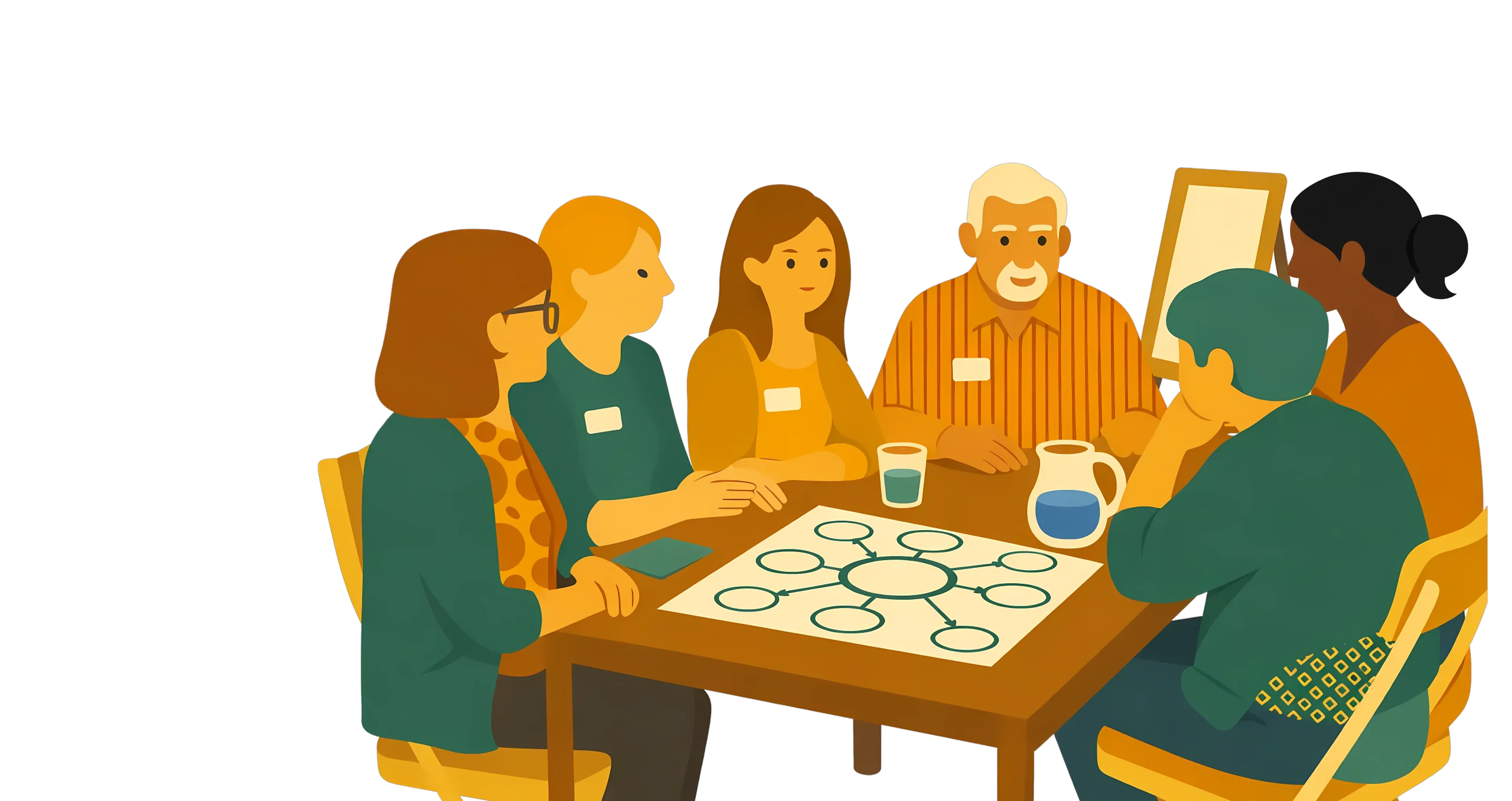
5 October 2026How can meaningful discussion and debate take place, when disagreement about sustainability issues becomes difficult or even conflictual? This summer, the Governing Sustainable Futures (GSF) team had the privilege to facilitate group discussions between members of the public on one of our four ‘flashpoints’, active travel and traffic reduction measures in and around Exeter. Together with a workshop series being undertaken in Autumn 2026, these so-called focus group discussions are a key participatory component in our methodological approach. Rather than suggesting what should or should not be done about traffic in Exeter, or any other similar flashpoint, our approach is to provide structured opportunities for stakeholders to take part in meaningful dialogue when topics have become heated.
A key part of the project focuses on developing and trying out innovative collaborative and participatory processes that can help communities, organisations and policymakers respond to conflicts or disagreements surrounding sustainability transitions in inclusive and constructive ways. As such, our focus is not on finding an agreed solution – sometimes disagreement is inevitable – but on developing ways to ‘disagree better’. In this blog post, we outline our approach to this r – what we call our methodology and methods.
Developing New Participatory Mechanisms
To find ways of disagreeing better, we work alongside community partners, Devon Communities Together and Resource Futures, as well as our strategic partners. Together, we design and try out participatory approaches tailored to place-based sustainability challenges, building on insights generated through earlier stages of the project (see Work Packages 1 and 2). Our participatory approaches aim to be collaborative, allowing individuals, communities, and organisations to shape decisions that affect them. At the core here is a commitment to ensuring that diverse voices are recognised, valued, and represented throughout decision-making processes. This approach is different to traditional ‘top-down’ models, which prioritise expert or technical knowledge over local experiences, community perspectives, and alternative forms of knowledge. At times, this can result in mistrust, disagreement, and even conflict around proposed solutions, whereas a collaborative process may create a sense of ownership and shared responsibility for decisions.
The first step in developing such a process is taking stock of what is already being done and what works well. This involves a review of existing research, literature, and practical experience, including the depth of expertise our community partners bring. This helps to identify promising approaches and specific methods that can then be adapted and refined for application to different contexts. Broadly speaking, methods here are tools or means for doing something, namely, to facilitate better conversations.
Trying out Different Participatory Methods
In our approach, we explore different participatory methods for engaging diverse voices through a series of workshops as well as focus groups. For each of our four flashpoints, the GSF team and our community partners carry out focus group discussions and workshops consisting of three themes: empathy building, identifying stakeholder and power relations, and visions of the future. Each flashpoint provides an opportunity to examine how conflicts emerge in specific places and contexts, how different groups understand the issues, and how more collaborative pathways can be developed.
The engagement process includes:
Focus Groups
Focus groups provide a space for exploring public perspectives on sustainability issues. They allow participants to share lived experiences, concerns, values, and ideas, helping us better understand how sustainability challenges are experienced at the community level. We are particularly interested in hearing the voices of what is often labelled the ‘silent majority’ to better understand what moves people and what matters to people. This summer, for example, members of the public gave views about traffic reduction measures and the processes surrounding the implementation of these schemes. These discussions are then followed by workshops, the first of which has taken place.
Stakeholder Workshops
A series of workshops brings together citizens, local organisations, businesses, policy makers and other relevant stakeholders – ie people or organisations with some kind of stake, in the issue. These sessions focus on three interconnected themes, all geared towards enabling better conversations:
1.Empathy-building
Drawing on existing practices and academic research on the importance of empathy, we explore using methods that build empathy that may facilitate better discussions. Based on existing studies, the underlying assumption here is that by putting ourselves in other people’s shoes, we may feel more empathetic towards people with differing views and have better conversations. For our recent first workshop series, we drew on storytelling methods and non-violent communication techniques to explore what role stories, active listening, and reflective practices could play in encouraging empathy, while still allowing room for disagreement, differences of opinion, or different perspectives.
2. Stakeholder and Power Mapping
This is then followed by exercises that map out different people, components, relationships and interconnections within a specific sustainability issue. Here, we draw on a method called ‘rich picturing’, which has been widely used in academic research and in policy and practice. Rich picturing allows a group of stakeholders to explore a situation through their own visual diagrams to open discussion and develop a rich understanding of the situation from different viewpoints. These exercises may also encourage empathy by helping stakeholders understand different perspectives and the broader systems shaping place-based, local issues. As part of this, we consider where power lies, and different forms of power – who has power in relation to information and communications, and who has power because of money, resources or authority, and whose knowledge is valued. Unpacking these dynamics can bring new understanding about inequalities and how power is exercised – sometimes without awareness – to shape outcomes.
3. Future Visioning
The final workshop component consists of participatory future visioning activities, which encourage participants to imagine desirable and achievable sustainable futures. By working towardsshared visions, stakeholders can work to identify common goals , whilst acknowledge areas where these goals may differ, and finding pathways for action despite differing priorities. Here, we draw on a range of activities and methods, including something called ‘appreciative inquiry’, an inclusive process that focuses on envisioning and creating a positive preferred future, as well as other methods for imagining different futuresAs we repeat the focus groups and stakeholder workshop series for each of the four flashpoints, we reflect on what worked well and what could be changed after each. Based on our learnings and where necessary, we will change or adapt the methods and tools we use. The aim is to try different approaches and learn from them, and to share this information with others.
From Better Dialogue to Real-World Impact
An important feature of our project is its emphasis on reflective learning and real-world impact. Insights generated through focus groups, workshops, and collaboration with our partners are continuously reviewed and refined. Ultimately, our aim is to develop a practical framework for communities in the form of a toolkit for responding to sustainability contestations in inclusive ways. By embedding collaboration throughout the project, GSF ensures that research is not conducted on communities and stakeholders, but with them. Our aim is that the project’s learnings will help navigate sustainability challenges on the ground, supporting communities, institutions, organisations and policymakers navigate complex sustainability transitions more effectively.
Author: Dr. Magdalena Rodekirchen
