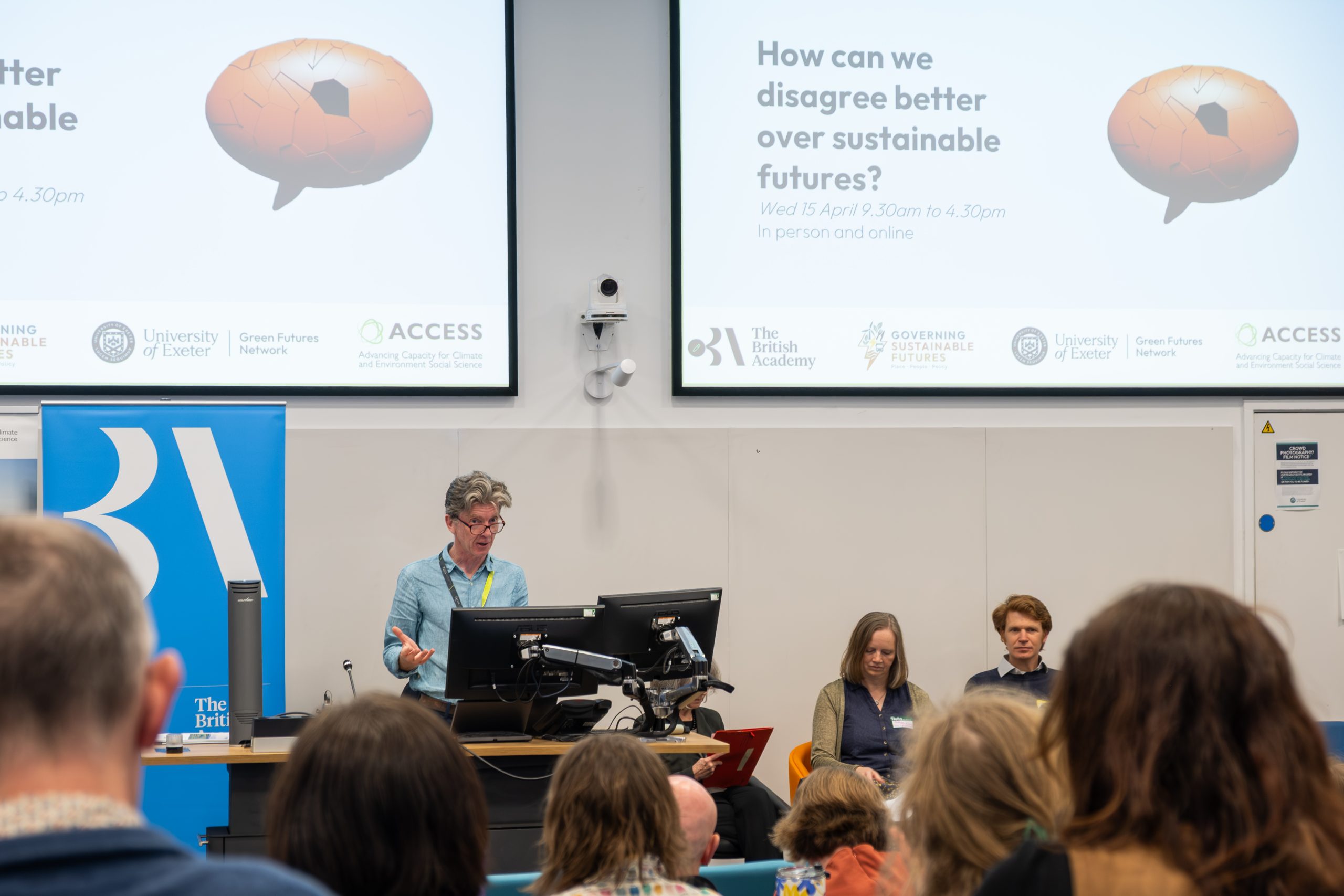
Conference Overview: How Can we Disagree Better over Sustainable Futures?
Posted by Candice
15 June 2026On April 15, 2026, Governing Sustainable Futures (GSF), along with partner organisations, ACCESS, Green Futures and the British Academy, held the first series of its regional events. The event brought together attendees and speakers from local government, community organisations, research institutions, and business to discuss one of the most urgent challenges of our time: how can we disagree better over sustainable futures?
Our motivation was clear: rather than seeing disagreement as a barrier, we asked whether disagreement can be a force for good. How could constructive disagreement become a catalyst for better governance, more meaningful participation and a more sustainable future?
The event started with provocations from three academics. Prof. Susa  Owens posited that disagreement is often good, will always exist and never be eliminated and mentioned four areas that needs consideration: institutional memory, understanding worldviews and debunking myths, trustworthiness. Prof. Karen Bickerstaff highlighted the limits of consensus and brought compelling examples to argue that disagreement can itself be constructive if engaged early, normalised as part of decision-making, and supported through processes that allow time, negotiation, and iteration. Prof. Ian Bateman pointed to the missing role of social science as well as its internal challenges: confronting misinformation effectively and working across sectoral and disciplinary boundaries.
 In the second session we heard from practitioners working in councils, communities, charities and consultancies. Emily Reed talked about contexts where decarbonistion efforts remain deeply contested and prone to polarisation. Nora Corkery drew attention to two themes: consultation fatigue and community organisations and charities as trusted intermediaries, whose brokerage role help build place-sensitive trustworthiness. Liz Gadd encouraged us to think about cultural challenges, posing the question of how to address disagreement where it is behind closed doors, indirect and obscured. The session closed by Emily Hobson’s hopeful remarks about getting a river catchment area beaver-ready.
The breakout discussions – online and in person- explored disagreement across 5 themes: renewable energy, rivers and the coast, mobility and transport, food and farming, nature and biodiversity. They encouraged participants to think about the challenges as well as the opportunities on the ground (we will be following up with further posts delving into the breakout themes).
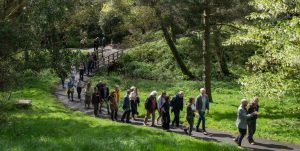
The afternoon session started after a ‘net-walk’ around the campus. We explored practical approaches and toolkits, including the Restoration Partnership Development Toolkit (Dr. Annette Green and Dr. Janet Fisher), Rural Climathons (Prof. Damian Maye) and The Co-Production Oracle (Hannah Mumby). These approaches took a departure from forms of consultation which sideline and proceed irrespective of disagreement. They aim to understand and embrace disagreement and offer ways to envision and build sustainable futures when diverging viewpoints exist.
The closing reflections by Susan Owens brought these threads together but also left us with the question of how to deal with ‘intractable problems’ issues characterised by deep uncertainty, conflicting values, and high political stakes.
GSF project will provide more opportities for dialogue to discuss these questions.
Author: GSF Project Team
