
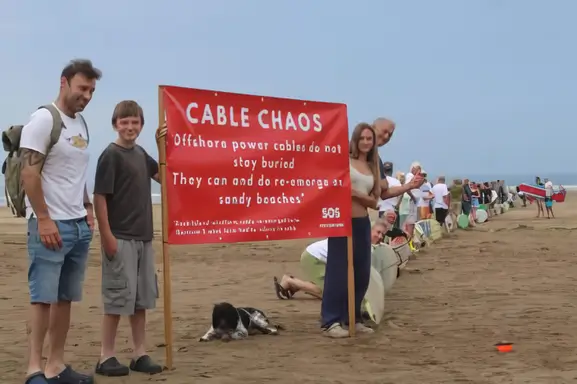
Photo credit : Helen Cooper (Save Our Sands)
Initiatives aimed at achieving energy policy targets by 2030 are transforming the UK’s energy sector, resulting in ongoing challenges related to the expansion of renewable energy. These national goals require significant upgrades to existing infrastructure, and National Grid is undertaking regional strategic planning to increase capacity for renewable power sources.
Increasing offshore wind capacity is considered vital for reaching these targets. While onshore wind farms have long been sites of contestation, it is often assumed that offshore projects will be less controversial. However, tensions can still emerge, for example from the infrastructure needed to deliver power ashore and connect to the grid, such as substations, cabling and pylons.
Previous offshore wind proposals (such as the Atlantic Array in the Southwest) have faced technical, environmental and community-based challenges. Technologies like floating offshore wind farms offer opportunities to deploy wind turbines further from shore, minimising visual impact in coastal areas, but they bring different challenges. For instance, areas like North Devon (Celtic Sea) have limited local grid connections due to low population density, meaning additional infrastructure must be built to connect these energy sources.
New infrastructure is often developed in ecologically sensitive rural and coastal areas. These areas are already experiencing shifts in land use, ownership and agricultural practices. Residents and environmental groups often voice concerns about the inequity of economic benefits from large-scale energy developments and the impact on the local environment and tourism industry.
Case Study
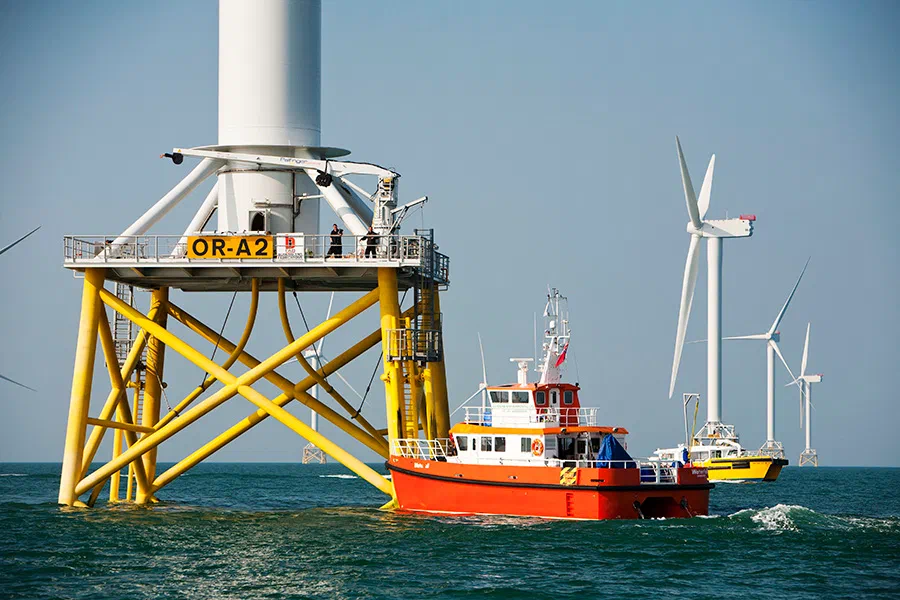
An offshore supply vessel transports workers to the Ormonde Offshore Wind Farm in the Irish Sea
White Cross Floating Offshore Wind Farm (FLOW)
The White Cross FLOW was selected as the case study for this flashpoint. The project is proposed by two companies working in partnership — Cobra and Flotation Energy — and consists of eight turbines located 31 miles offshore in the Celtic Sea. Offshore cables are planned to make landfall at Saunton Sands beach and connect to a new onshore substation via underground cables in East Yelland. Although objections were raised, planning consent was approved in August 2025 by North Devon Council and the Marine Management Organisation.
Objections focus on the environmental, social and landscape effects of the cable route needed to link the offshore turbines to the new substation at East Yelland. The route crosses protected areas — Special Areas of Conservation, Sites of Special Scientific Interest, a UNESCO Biosphere Reserve and an Area of Outstanding Natural Beauty. Opponents fear disruption to sensitive habitats such as marshes, peatlands and the surf ecosystem at Saunton Sands. The project has mobilised protests within the community.
